
Although severe cases of COVID-19 are often due to difficulty breathing and the malfunction of the lungs, the presence of pre-existing conditions, like Diabetes mellitus, can also put patients in critical condition. Type 2 Diabetes mellitus develops as insulin, which is produced by Beta Islet cells in the Pancreas, loses its ability to convert glucose into energy. Studying the Pancreas and molecules associated with it can help prove that COVID-19 infection may intensify underlying Type 2 Diabetes. COVID-19 enters the cell by attaching to ACE2 receptors, which line the alveolar cells in the lungs, leading to the malfunction of the lungs. But ACE2 receptors aren’t just found in the lungs, ACE2 expression is found in the exocrine pancreatic glands and the Islets. In fact, there are higher messenger RNA levels of ACE2 in the Pancreas than there are in the lungs. Entry of COVID-19 virus into pancreatic cells leaves the organ vulnerable to alteration- even worsening- of underlying Type 2 Diabetes.
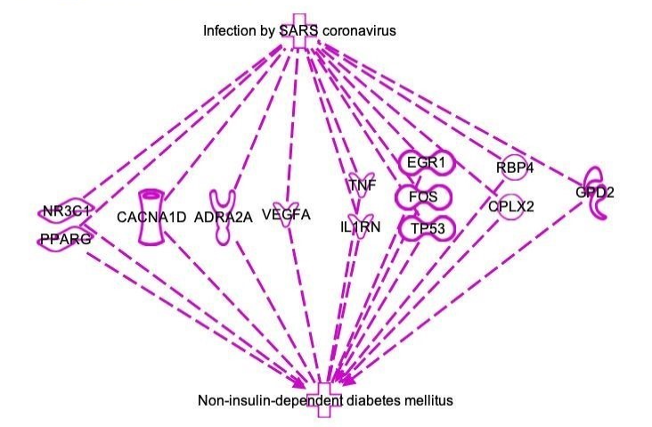
Ingenuity Pathway Analysis (IPA), a software used to conduct meta-analysis, allows the user to view, sort, and analyze molecules associated with diseases and functions, through various visual representations. The ¨My Pathway” tool in this software generated 34 molecules in the Beta Islet Cells which were associated with infection of SARS coronavirus.
Of those 34 molecules, 13 were also associated with non-insulin dependent diabetes mellitus. These molecules are Glucocorticoid (NR3C1), Peroxisome proliferator-activated receptor gamma (PPARG), Calcium Voltage-Gated Channel Subunit Alpha1 D (CACNA1D), alpha-2A adrenergic receptor (ADRA2A), Vascular endothelial growth factor A (VEGFA), Tumor Necrosis Factor (TNF), interleukin-1 receptor antagonist (IL1RN), early growth response 1 (EGR1), Fructo-oligosaccharides (FOS), Tumor protein P53 (TP53), Retinol binding protein 4 (RBP4), Complexin-2 (CPLX2), and Glycerol-3-phosphate dehydrogenase (GPD2).
TNF is one of these 13 molecules which plays an important role in COVID-19 infection with underlying Type 2 Diabetes. COVID-19 infection increases TNF concentrations, as it is secreted by macrophages in a pro-inflammatory response. This increased concentration of TNF can have worsening effects on Type 2 Diabetes, due to the impact on glucose metabolism. Studies show that TNF inhibits insulin transduction, which increases Insulin Resistance. Not only does IPA shows that TNF is related to 384 of the 719 molecules associated with Insulin Resistance, but it also has a causal relationship with the condition. This suggests that COVID-19 worsens underlying Type 2 Diabetes by raising TNF levels and increasing Insulin Resistance.
While TNF shows a promising correlation between the two conditions in the pancreas, it is just one of these 13 molecules. A core analysis of these 13 molecules through IPA highlights Acute Phase Response Signaling as the top canonical pathway associated with these molecules. The molecules involved in this response are TNF, IL-1, NR3C1, FOS, and RBP4. Since both COVID-19 and Type 2 Diabetes are capable of disturbing homeostasis within the body, this response is likely to be activated and cause complications for both diseases.