
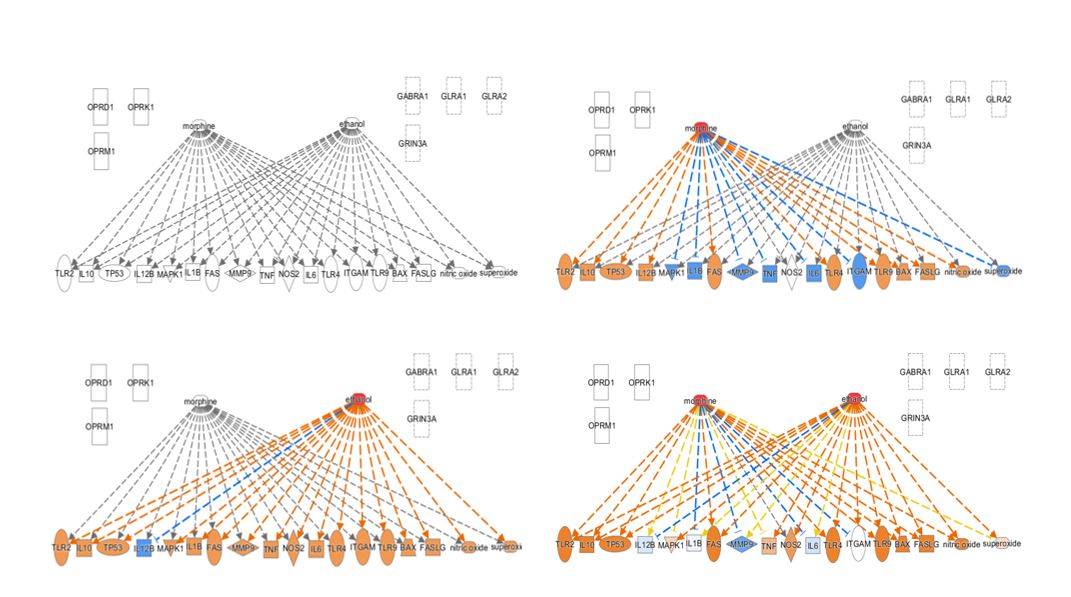
Alcoholism and alcohol-related deaths are the third leading cause of preventable death in the US. A fourth of all Americans engage in some form of binge-drinking every week. Side effects of excessive or moderate alcohol use may include stupor, unconsciousness, or analgesia. The effects produced by alcohol (ethanol) mimic the effects produced by many analgesics and anesthetics commonly used by physicians for surgical procedures such as ketamine, morphine, or buprenorphine. Morphine specifically exerts its effect by activating the κ, δ and µ opioid receptors. Its effects include drowsiness, constipation, and most notably analgesia. Ethanol activates gamma aminobutyric acid (GABA), glutamate and glycine receptors. Although these receptors may be different, ethanol likely shares common downstream molecules with morphine that modulates its effects, because of their shared activity. To substantiate our interpretation, we have employed Ingenuity Pathway Analysis (IPA) from QIAGEN to establish any common pathways, receptors, or molecules associated with morphine- and ethanol-mediated effects. Existing literature shows that morphine and ethanol have pro-Inflammatory effects. Although ethanol at high concentrations is pro-inflammatory, at low concentrations it exhibits anti-Inflammatory activity. We thus predict, utilizing IPA, ethanol and morphine will share downstream molecules, which modulate the activity of pro-Inflammatory (IFNγ, TNFα) and anti-Inflammatory (IL-4, IL-13) cytokines. Our in-silico studies showed ethanol and morphine share 18 intermediary molecules in all cell types/lines including macrophages. At a systemic level, our findings support our hypothesis. Morphine showed to be pro-inflammatory, in addition to activating the µ receptor. Ethanol findings demonstrated an anti-inflammatory response, consistent to the findings in macrophages. In addition, we found that increasing levels of ethanol showed activation in each of the common 18 molecules except IL-12β and ITGAM. Ethanol activates the µ receptor, inhibits the δ receptor, and shares no connection to the κ receptor. In addition, the only cytokine inhibited was IFNγ, the rest were activated with increasing levels of ethanol. When the levels of both morphine and ethanol were increased, the molecules most significantly affected were IL-12β, IL-6, IL-10, TLR4, MAPK1 and IL-1β. In addition, all the common 18 molecules examined activated µ and inhibited δ, for the exception of IL-10, which inhibited both receptors. Based on our IPA analysis, any synergism between ethanol and morphine and the involvement of these 18 intermediary molecules in the regulation of IFNγ, TNFα, IL-4 and IL-13 can be established using in vitro studies.
December 28, 2025