
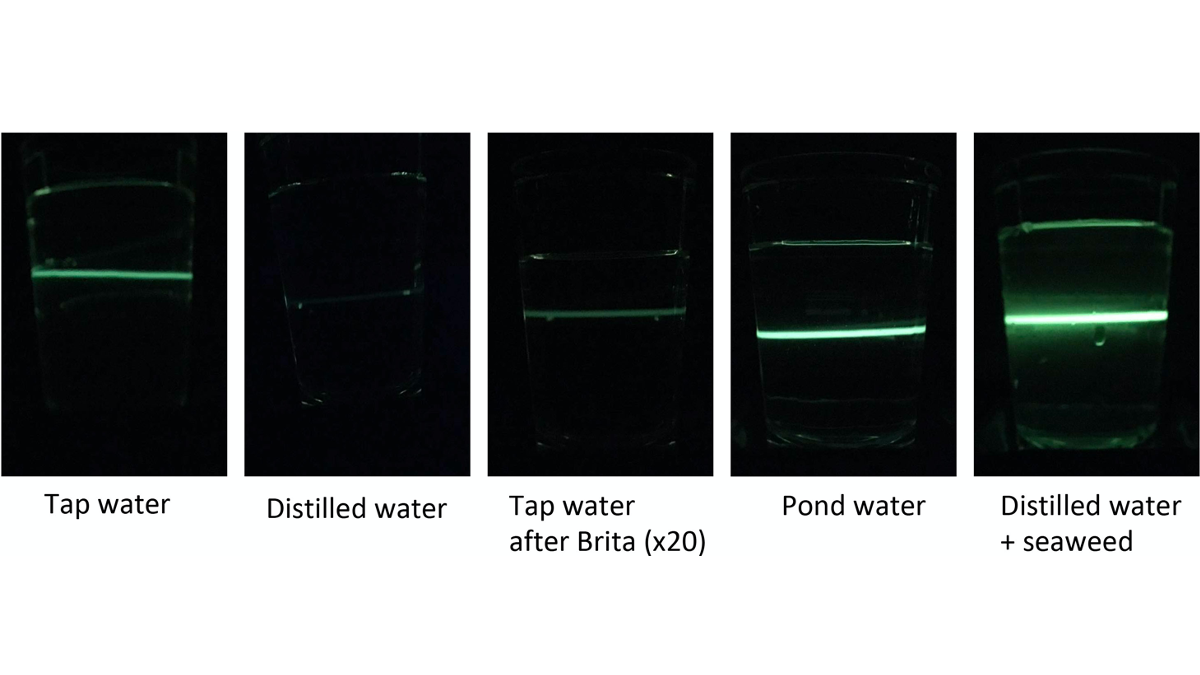
BACKGROUND:’Most of the earth’s abundant water is not usable for … human consumption, and the world’s population is threatened with critical shortages’ (“Silent Spring”, Rachel Carson). For example, in part of Africa, 40% of the population is left without access to clean drinking water. Water pollution due to the environmental destruction caused by economic development is a worldwide issue of pressing importance. Natural disaster adds to the existing problem of water pollution. When hurricanes hit the coastal area, residents became inaccessible to clean water. Clean water accessibility and public health are very closely linked. (1) I would like to introduce the new sensitive method I have developed to check the quality of water by illuminating the water with a Laser-pointer (see image below), based on my serendipity discovery that impure water fluoresces in green. (2) Next I would like to discuss the new method that can tell us how much bacterial contamination exists in the water.
METHODS: Two subgroups of experiments were performed to check the impurity of water by the inherent fluorescence. (1) Starting with the tap water, I tried to remove the fluorescence by (a) using Brita filtration, (b) boiling, (c) changing the pH, or (d) adding bleach. (2) Next, starting with distilled water, I tried to create similar fluorescence to the one I observed in the tap water, by adding various potential contamination substances.
RESULTS: Filtration of the tap water through Brita removed the fluorescence, confirming the existence of fluorescent substances in the tap water. However, none of the boiling or treatment with acid or bleach removed the fluorescence, suggesting that this impurity is acid- and bleach-resistant. Next, starting with distilled water, I added different impurity materials one by one. Things derived from plant sources (seaweed, etc) gave strong fluorescence, whose color was similar to that in the tap water.
CONCLUSIONS & FUTURE DIRECTIONS: The laser illumination method can successfully detect the amount of water contamination, which is likely from the residual impurity made of organic substances from a plant source. I have constructed a prototype of a device that includes references to both negative and positive signals, which will hopefully develop into an affordable tool for water quality checking in the necessary countries. This device, however, only serves a quick quality check but does not give information about whether there is bacterial contamination. To detect the bacterial content in the water, there have been methods like, ‘LAL reaction’. In the presence of lipopolysaccharide (LPS), a cell wall constituent of many bacterial species, blood components of horseshoe crabs start a chain reaction enabling the detection of LPS. However, sacrificing horseshoe crabs to monitor the quality of water is not sustainable. I would like to discuss what could be done to substitute this method.
December 28, 2025