
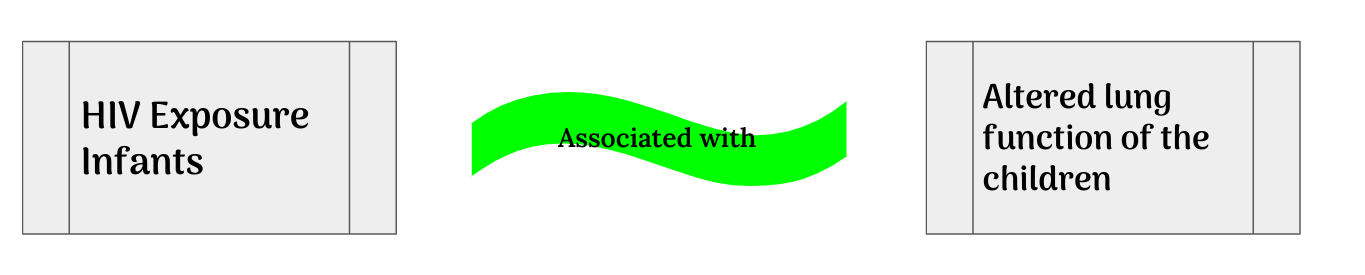
Background: Early life exposures can have lifelong impacts on health. Children who are HIV-exposed but uninfected (HEU) are found to have altered lung function at the age of 6 weeks and 2 years. However, it is unclear how maternal HIV infection affects the lung function of the children at later life at the molecular level.
Methods: Differential Gene Expression (DGE) analysis was performed on the gene expression data of 144 umbilical cord blood samples (26% HEU, 74% unexposed) from the Drakenstein Child Health Study (DCHS). Fast gene set enrichment analysis ( fGSEA) was used to evaluate the enrichment of Gene Ontology (GO) terms and Kyoto Encyclopedia of Genes and Genomes (KEGG) pathways. Biologically meaningful clusters (modules) of co-expressed HEU associated genes were determined using weighted gene co-expression network analysis (WGCNA). The
association of the hub genes from the HEU-associated modules and the lung function (tidal volume) at 6 weeks and 2 years of age of the children was assessed using linear regression.
Results: SRXN1 was significantly differentially expressed between HEU and unexposed infants. fGSEA identified enrichment of 243 GO terms and 24 KEGG pathways in HEU infants, the majority of which were related to immune function or inflammation. WGCNA identified two clusters associated with HEU, with hub genes enriched in immune related pathways. Hub genes were associated with offspring lung function (P <0.05).
Conclusion: HEU offspring exhibited differential gene expression in cord blood, in comparison to unexposed infants, with enrichment in immune response pathways. Expression of HEU enriched genes was associated with lung function, suggesting the association of HIV exposure with offspring lung function is mediated by altered gene expression in-utero.