
Objective: COVID-19 has spread rapidly worldwide since its emergence in 2019 and has become a significant health threat to human. As of November 2023, there had been 772,052,752 confirmed cases of COVID-19 worldwide, including 6,985,278 deaths. A recent study suggests that genetic biomarkers may be helpful in identifying relevant clinical outcomes. Therefore, identifying certain biological markers can be used to indicate the severity of the disease and its prognosis. In order to better understand the relationship between patient genetic characteristics and COVID-19 mortality, machine learning can be used to analyze and identify patterns associated with COVID-19 mortality. The present study aims to analyze the available data in Center for Disease Control (CDC) and World Health Organization (WHO) on mortality in the older adult population compared with its younger counterparts.
Design: In this study, we focused distribution of mortality rate among the different age groups due to COVID-19 infection among 8,786,264 subjects in USA during the year 2020-2023. This information was collected from the public resources available in Center for Disease Control (CDC) and World Health Organization (WHO). We used computational techniques with Python tools and curated the available data from the above two resources. We used multivariable logistic regression to examine the association of pre-existing health conditions with COVID-19 deaths.
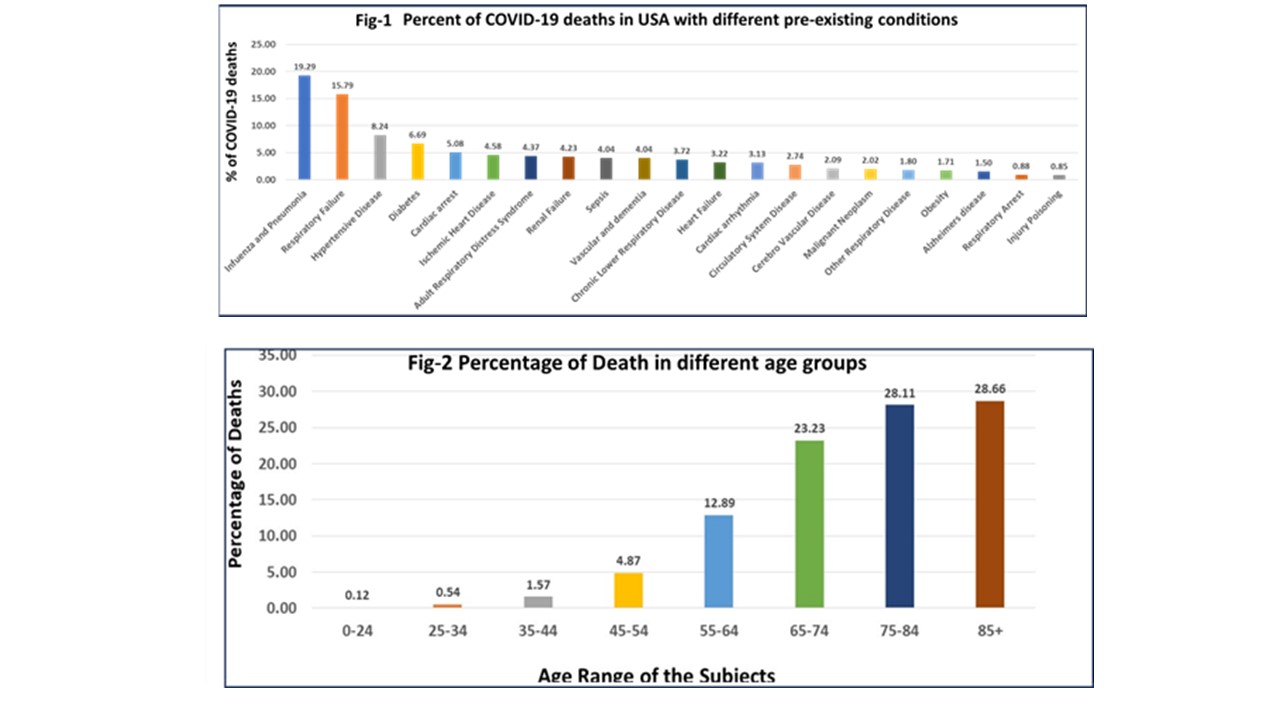
Results: A total of 8,786,264 subjects were analyzed. The mortality rate was analyzed based on the pre-existing medical condition as a major risk factor. The analysis showed that the population with influenza and pneumonia and with respiratory failure had highest mortality rate of 19.29% and 15.79 % respectively (Fig-1). The mortality rate in different age group was also compared(Fig-1). The analysis revealed that in patients aged higher than 85 years was 2,518,191 (28.66%). In 75-85 years of age, the mortality rate was 2,470,115 (28.11%). In 65-74 years the rate was 2,041,177 (23.23%). 55-64 years was 1,132,914 (12.89%). 45-54 years was 427,750 (4.87%). 35-44 years was 137,943 (1.57%). 25-34 years was 47,537 (0.54%). Lastly, 1-24 years was 10,642 (0.12%). The key findings of this analysis is an exponential increase of COVID-19-related mortality exists with age and within the population with pre-medical conditions. Previous studies has shown that during aging, the immune system activation decline in its function called immunosenescence, which can hampers pathogen recognition, alert signaling and cause excessive lung damage. To summarize, the key findings of this analysis is an exponential increase of COVID-19-related mortality exists with age. Previous studies has shown that during aging, the immune system activation decline in its function called immunosenescence, which can hampers pathogen recognition, alert signaling and clearance. Further it is also shown that during aging, chronic increase in systemic inflammation arises from an overactive, and might be responsible for the excessive lung damage.
Conclusion: Based on our studies it is implied that the proper medical treatment with the use of antivirals in old age populations is primarily needed for the COVID-19 infections.