
Introduction: Hepatocellular Carcinoma (HCC) is a highly fatal disease in which race/ethnicity plays a vital role in determining incidence, mortality, and survival rates. The incidence of HCC is highest in Asia and Africa. Furthermore, there is a statistically significant increase in incidence and mortality and a decrease in 5-year survival rates in African American (AA)/Black patients compared to non-Hispanic white patients. To understand the underlying cause, we performed bioinformatics on existing gene expression data. We found that type I Interferon (IFN-I)-inflammatory signaling pathway showed statistically significant activation in AA/Black patients compared to white patients. Due to the severe toxicity of the currently available cancer treatments, there is also a demand for the development of alternative therapies with high efficacy and low side effects to treat liver cancer.
Hypothesis: We hypothesized that dietary compounds, because of their anti-inflammatory property, might modulate the IFN-I signaling pathway in HCC.
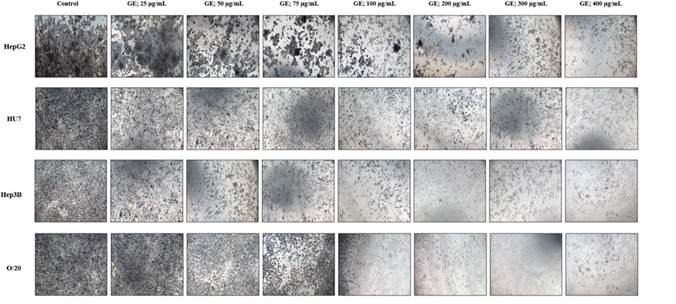
Objectives: To determine (a) effects of anti-inflammatory ginger extract on proliferation of HepG2 (white patient), Hep3B and O/20 (Black patients) and HuH-7 (Asian Patient) cell lines and investigate ginger effects on the INF-1 mediated signaling pathway.
Methods: A dose-response of these extracts was used to determine IC50s on these cell lines using an MTT cell proliferation assay. Activation of INF-1-mediated downstream signaling proteins, including JAK1, TYK2, STAT1, and STAT2 phosphorylation status, was determined on a Western blot analysis. The expression of Interferon Signaling Genes (ISGs), including Myxovirus resistance gene 1 (MX1), 2′,5′-oligoadenylate synthetase (OAS1), Interferon-alpha inducible protein 6 (IFI6), and Interferon stimulated gene 15 (ISG15) was assayed using a quantitative Real-Time Polymerase Chain Reaction (RT-PCR).
Results: Ginger has a significantly (P<0.05) lower IC50s (g/ml) on cell lines from Black patients (Hep3B=160 ± 3, and O/20=162 ± 3) than cell lines from white (HepG2=176±5) or Asian (Hu7=174 ± 5) patients. Ginger treatment reduced the phosphorylation of IFN downstream mediators in all HCC cell lines. Furthermore, expression of MX1, ISG15, IF16, and OAS1 was also reduced in all HCC cells lines in a dose-dependent manner; however, the effects on gene expression were more sensitive to a lower concentration of ginger extract in Black patients derived HCC cell lines than other HCC cell lines.
Conclusions: Considering the role of pro-inflammatory and immunosuppressive functions of IFN-I, AA/Black HCC patients might benefit from combination of dietary anti-inflammatory agents and chemo/immunotherapy.
Future Directions: Currently, research is underway to identify the active chemical agent in ginger and test it on other patient-derived HCC lines and in an in vivo model.
December 28, 2025