
Background: During my volunteer experience playing jazz violin for senior individuals, I observed that many aging people gradually lose their hearing capability and eventually cease to enjoy listening to music. Additionally, in conversations with my grandparents, I discovered that they don’t derive as much enjoyment from music as they did in their younger years. Consequently, I envisioned a project to convert the tone of music into the ‘dancing pattern’ of LED lights. Through Python coding on Raspberry Pi connected to Arduino and LED, I aimed to create a device attached to the violin that senses the tone and volume of the music, converting the audio information into a dancing pattern of LED lights with varying colors.
Aims:
(1) I aim to test whether information such as tone (pitch), volume, and rhythm of the music can be extracted through the microphone connected to Raspberry Pi using Python coding.
(2) I aim to process the information and output the processed data through a digital-to-analog converting electrical circuit to feed into LEDs (through Arduino).
Novelty: While there have been many LED projects utilizing LED displays/strips as an interface for audio systems, many of these projects only extracted the intensity of the sound wave, simply feeding the information into the LED control. In my new project, I plan to extract not only the volume of each tone but also multiple parameters, including the tune of the music, wavelength, rhythm, etc. I intend to perform real-time signal processing to control the pattern and color of the LED strip, maximizing the impact of the visual effect.
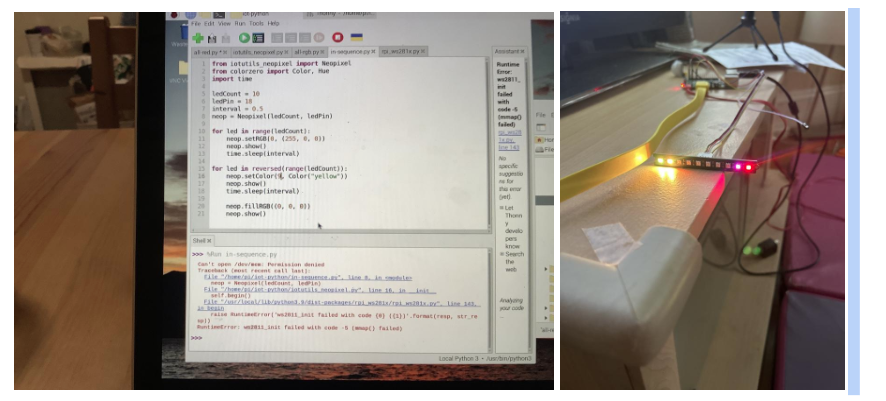
Preliminary Progress: As illustrated in Figure 1, I have developed a Python code (Fig. 1) that enables LED strip illumination (Fig. 2) according to the sound picked up by a microphone.
Future Plans:
(1) We plan to upgrade the system to Raspberry Pi 4.
(2) We plan to interface Raspberry Pi 4 and Arduino in a master-servant relationship connected by serial communication.
(3) We plan to use a longer LED strip.
(4) We plan to implement a USB audio input interface to enable Raspberry Pi 4 to perform real-time signal processing.