
Coronary artery disease (CAD) remains one of the leading causes of morbidity and mortality worldwide. Although current treatments focus on managing risk factors and restoring blood flow, they do not directly correct the underlying genetic contributors to atherosclerosis. Advances in genome‑editing technology, particularly CRISPR‑Cas systems, offer the potential to modify or silence genes involved in lipid metabolism, inflammation, and vascular dysfunction. Our Poster explores emerging CRISPR‑based strategies targeting key genetic pathways implicated in CAD, highlighting recent breakthroughs, therapeutic potential, and translational challenges. A narrative review of contemporary literature (2020–2025) was conducted, focusing on CRISPR‑Cas9, base editing, and prime editing applications relevant to CAD. Key research areas included LDL‑cholesterol regulation (PCSK9, ANGPTL3), vascular smooth muscle cell behaviour, plaque stabilization, and preclinical in‑vivo genome editing approaches.
CRISPR-mediated gene targeting demonstrated significant reductions in LDL-C levels through PCSK9 disruption, improved plaque stability, and modulated inflammatory pathways in multiple animal models. Novel delivery platforms—such as lipid nanoparticles and viral vectors—enhanced editing efficiency with lower off‑target effects. Early translational studies suggest durable, single‑dose therapeutic impact. CRISPR technology represents a promising frontier for addressing the genetic roots of CAD. While safety, delivery optimization, and ethical considerations remain challenges, ongoing advances position gene editing as a potential future therapy capable of transforming cardiovascular disease management.
December 25, 2025
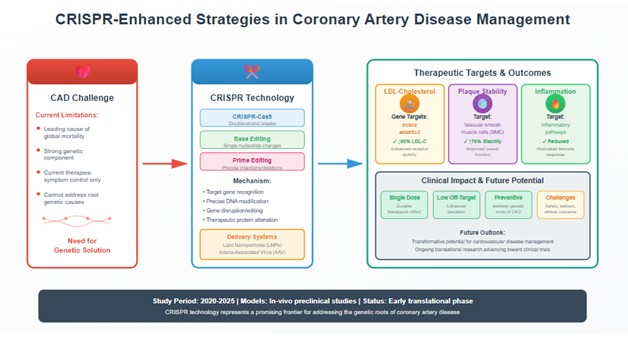
CRISPR-Enhanced Strategies in Coronary Artery Disease (Cad) Management
Authors List :
Raghad Ara and Bushra Iman
Presenting Author :
Raghad Ara and Bushra Iman
Affiliations :
Department of Biotechnology, Anwarul Uloom College (Autonomous), Mallepally, Hyderabad, TS, India.
Email :
princess.raghad20@gmail.com
Key Words (5 Words Maximum) :
CRISPR-Cas9, Coronary Artery Disease, LDL-cholesterol, gene editing, precise medicine.