
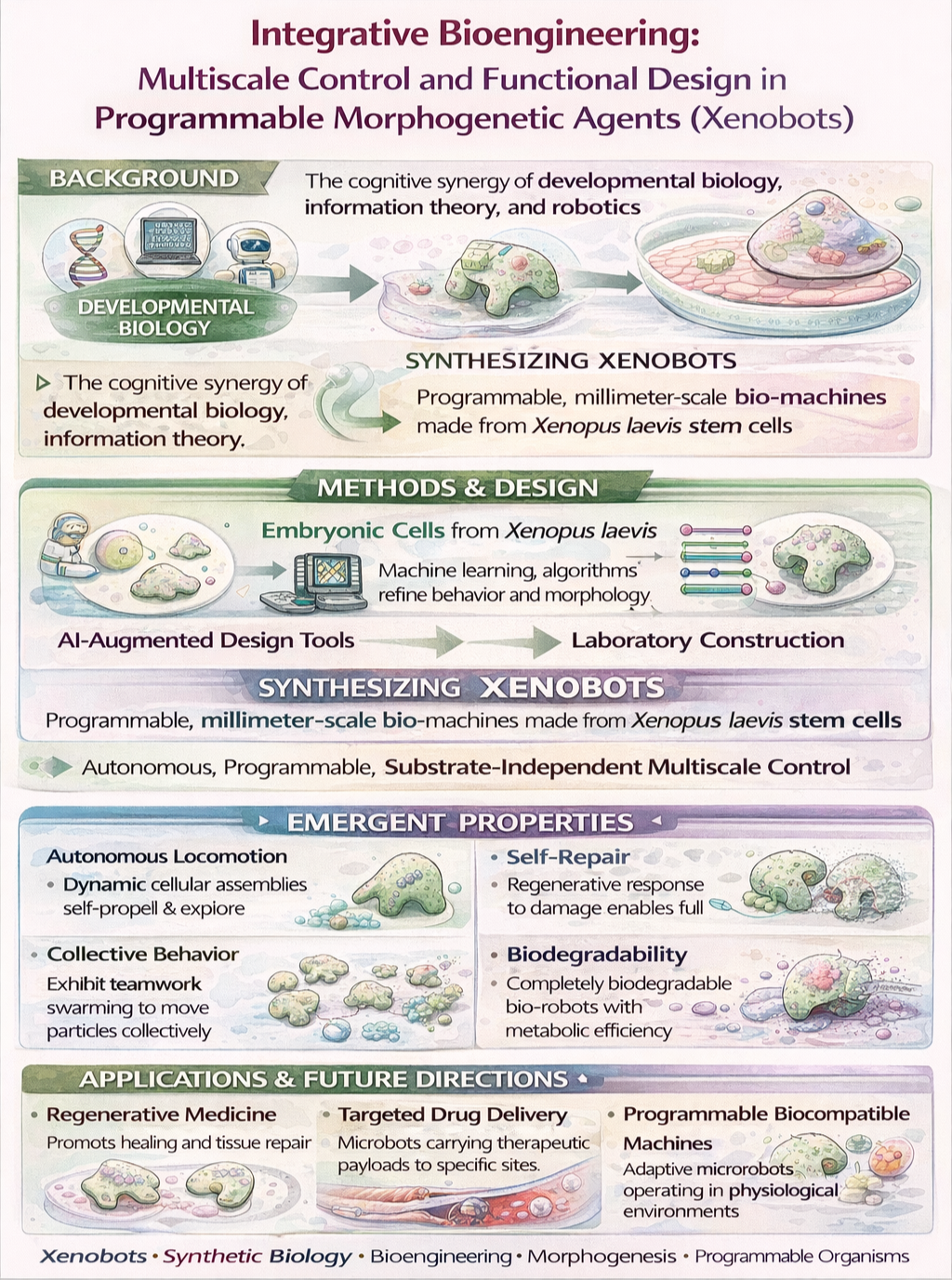
The emergence of synthetic biological machines necessitates a departure from classical reductionist frameworks toward an integrative paradigm combining developmental biology, information theory, and robotics. This study evaluates the transition from passive cellular assemblies to autonomous, programmable living systems, characterized by the development of “Xenobots”—millimeter-scale bio-machines derived from Xenopus laevis progenitors. We analyze the synthesis of these organisms through the lens of computational morphogenetics and multiscale control. By repurposing pluripotent contractile and epithelial cells, these constructs are engineered to execute specific kinematic tasks. We examine the principles of self-assembly and functional plasticity, arguing that organizational control mechanisms are substrate-independent and can be modeled using algorithmic frameworks. Xenobots demonstrate unique emergent properties, including autonomous locomotion, collective behavior, and robust self-repair following physical trauma. Unlike traditional soft robotics, these biological agents offer complete biodegradability and metabolic efficiency. The synthesis of these systems challenges the conventional dichotomy between “living organisms” and “engineered machines,” suggesting that biological media can serve as a programmable interface for complex task execution. The convergence of developmental biology and bioengineering provides a robust framework for designing adaptive, biodegradable tools for targeted drug delivery and regenerative medicine. By leveraging the inherent intelligence of cellular collectives, this integrative approach opens new frontiers in the creation of biocompatible machines capable of operating within complex physiological environments.
December 28, 2025