
Background: Weather-related headaches have been reported more frequently during rainy season, particularly in fall and winter. Previous researcher suggested that changes in barometric pressure can cause headaches, dizziness, or join pain, this condition is known as meteropathy. Approximately 30% of the global population or 2.4 billion people experience weather-related physical symptoms. Although meteoropathy is not life-threatening, it can significantly affect daily functioning quality of life.
Barometric pressure is the pressure caused by the weight of the air. Change in barometric pressure can affect the middle ear, an air-filled cavity connected to the back of the nose through Eustachian tube. Under normal conditions, this tube equalizes internal and external air pressure. However, when barometric pressure changes rapidly, the eustachian tube may not open properly. This can create imbalances of pressure, placing stress on the eardrum and disturbance in inner-ear fluids balance. These changes can interfere with signals sent to the brain, potentially causing headaches, dizziness, or even fainting.
To investigate the relationship between barometric pressure and headaches, and weather-related headaches, long-term barometric data were analyzed using NASA Earth observation datasets.
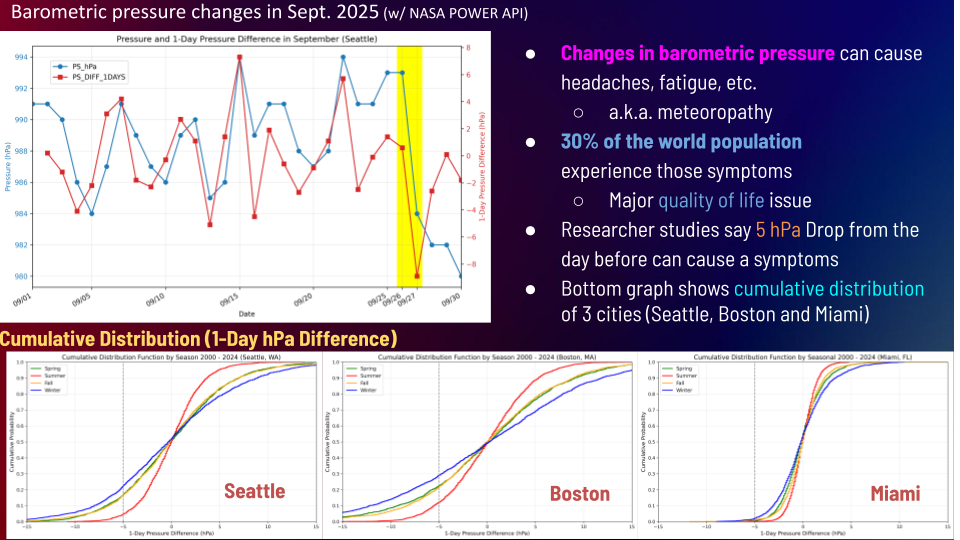
Results: The data recorded on September 2025 reveal a significant drop in barometric pressure between September 26 and 27, with a decrease of approximately 9 hPa within one day. Previous research indicates that pressure drops as small as 5hPa can increase the likelihood of meteoropathy symptoms, suggesting that this rapid decline represented a high-risk condition for weather-related headaches.
Further analysis involved comparing cumulative distribution function graphs of Seattle, Boston and Miami. Each line on the graph represents a season (spring, summer, fall, or winter), and the vertical line at x = -5 hPa marks the threshold at which weather-related symptoms are more likely to occur. In Seattle, the probability of experiencing a pressure drop of 5 hPa is only about 4% in summer but increases dramatically to about 22% in winter. Boston shows a similar but slightly higher pattern, while Miami remains below 5% across all seasons, indicating a lower likelihood of weather-related symptoms. The difference is likely due to Miami more stable climate, whereas Seattle and Boston are more frequently affected by strong storm system. In conclusion, the data strongly suggested a clear relationship between barometric pressure change and weather-related headaches. Large barometric pressure changes occur much more often during fall and winters, especially in cities like Seattle and Boston. These frequent pressure changes explain why weather-related headaches are more common during colder seasons. Understanding these patterns can help explain how weather is related to human health and why some regions experience more symptoms than others.
December 25, 2025
The Relationship Between Barometric Pressure Changes and Weather-Related Headaches
Authors List :
Konomi Karube
Presenting Author :
Konomi Karube
Affiliations :
Lake Washington High School
Email :
ko.karube@outlook.com
Key Words (5 Words Maximum) :
Headache, Barometric Pressure, Weather, Meteropathy