
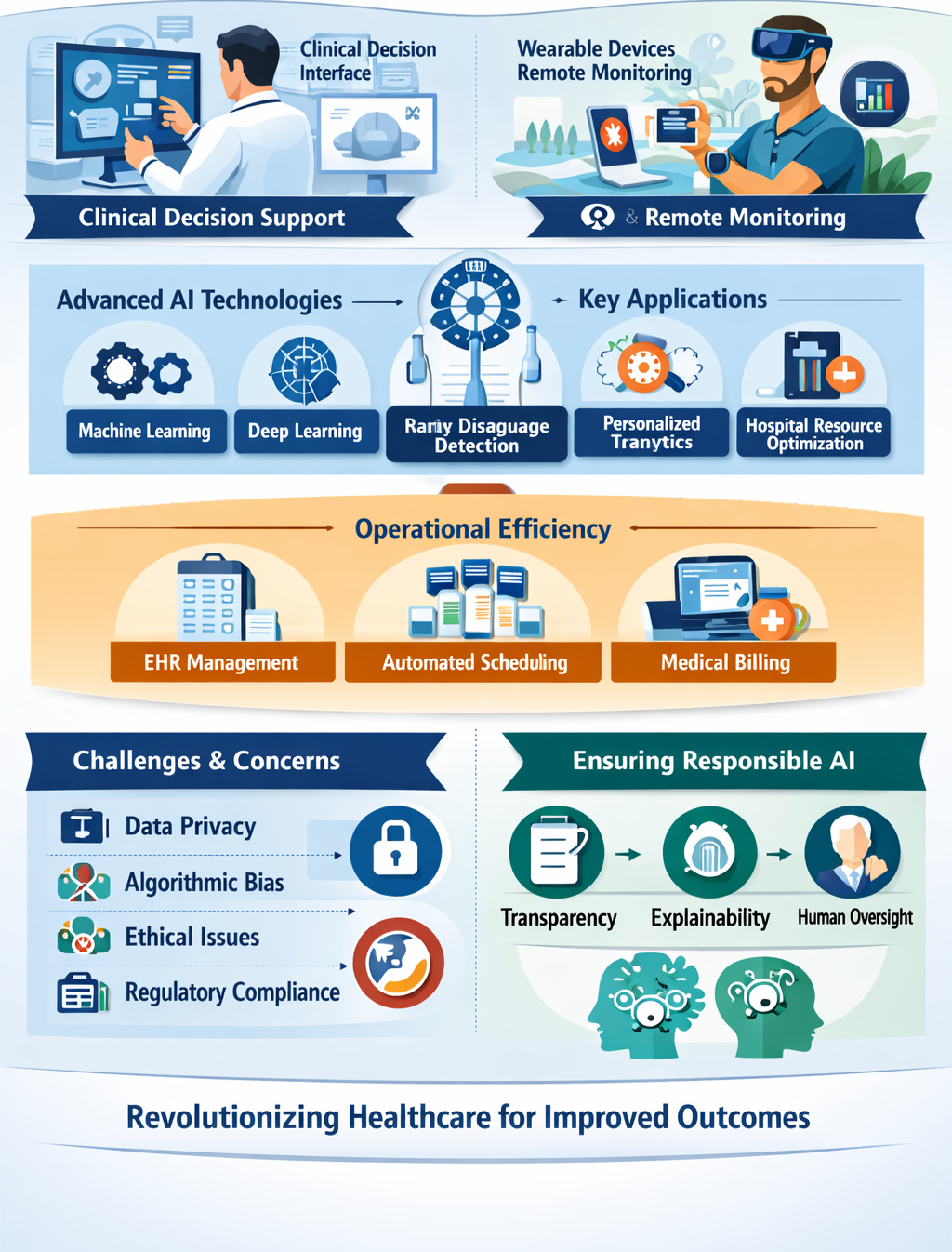
Artificial Intelligence (AI) has emerged as a pivotal driver of innovation in healthcare, reshaping diagnostic, therapeutic, and administrative paradigms. Recent systematic reviews highlight AI’s capacity to enhance clinical decision-making, medical imaging interpretation, and personalized treatment planning, thereby reducing diagnostic errors and improving patient outcomes. Advanced methodologies such as machine learning, deep learning, and natural language processing enable the rapid analysis of complex datasets, supporting early disease detection and predictive analytics for patient deterioration, epidemic surveillance, and hospital resource allocation. Beyond clinical applications, AI contributes to operational efficiency by automating administrative workflows including electronic health record management, patient scheduling, and billing, allowing healthcare professionals to devote greater attention to patient-centered care. The integration of AI into wearable devices and remote monitoring systems further facilitates continuous patient observation and proactive health management. Despite these advances, challenges persist. Concerns regarding data privacy, ethical governance, algorithmic bias, and regulatory compliance remain central to responsible AI adoption. Ensuring transparency, explainability, and human oversight is critical to mitigating risks and fostering trust among stakeholders. Overall, AI demonstrates immense potential to revolutionize healthcare by improving efficiency, accuracy, and accessibility of medical services. Sustained interdisciplinary collaboration, coupled with robust ethical frameworks, will be essential to harness AI’s transformative capabilities for building a resilient, equitable, and patient-centered healthcare ecosystem.
December 28, 2025