
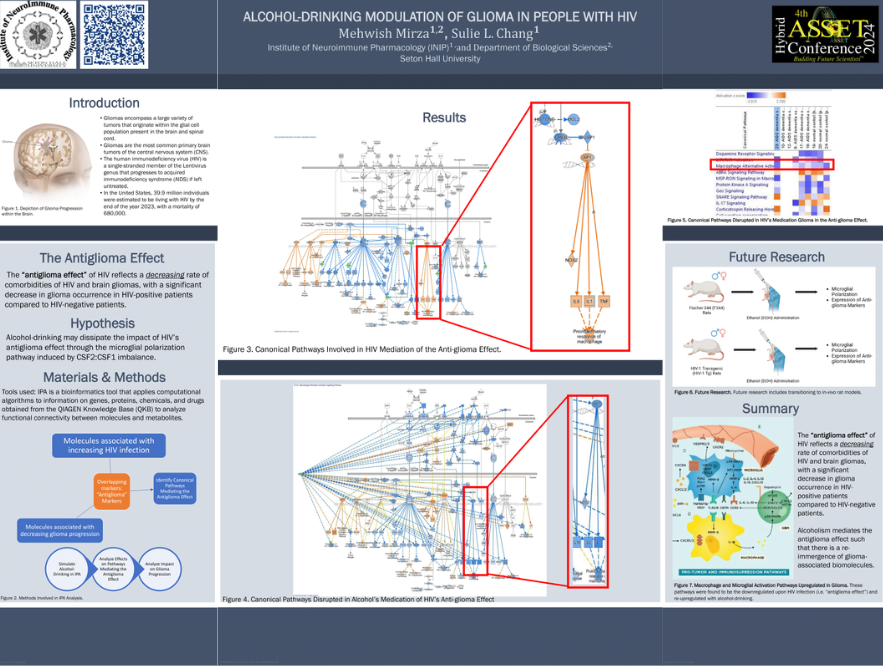
Gliomas encompass a large variety of tumors that originate within the glial cell population present in the brain and spinal cord. These tumors are the most common primary brain tumors of the central nervous system, yet their invasive nature presents difficulty in treatment. The human immunodeficiency virus (HIV) is a single-stranded member of the Lentivirus genus that progresses to acquired immunodeficiency syndrome (AIDS) if left untreated. 39.9 million individuals were estimated to be living with HIV by the end of the year 2023, with a mortality of 680,000. The “antiglioma effect” of HIV reflects a decreasing rate of comorbidities of HIV and brain gliomas, with a significant decrease in glioma occurrence in HIV-positive patients compared to HIV-negative patients. In this study, it is hypothesized that alcohol-drinking may dissipate the impact of HIV’s antiglioma effect through the microglial polarization pathway induced by CSF2:CSF1 imbalance. Utilizing QIAGEN’s Ingenuity Pathway Analysis (IPA), microglial activation was identified as a statistically significant, top-ten canonical pathway. Through both an IPA in-silico analysis and in-vivo rat study, it was discovered that, in gliomas, an imbalance in the ratio of colony stimulating factor 2 (CSF2) to colony stimulating factor 1 (CSF1) stimulates microglia polarization. CSF2 steers microglial polarization towards a pro-glioma state, in which the ratio of M2 microglia to M1 microglia is increased. HIV dissipates the effects of CSF2-mediated pro-glioma microglial polarization, but alcohol-drinking was discovered to re-introduce pro-glioma polarization, suggesting a dissipation of the antiglioma effect of HIV in glioma patients.
December 28, 2025