
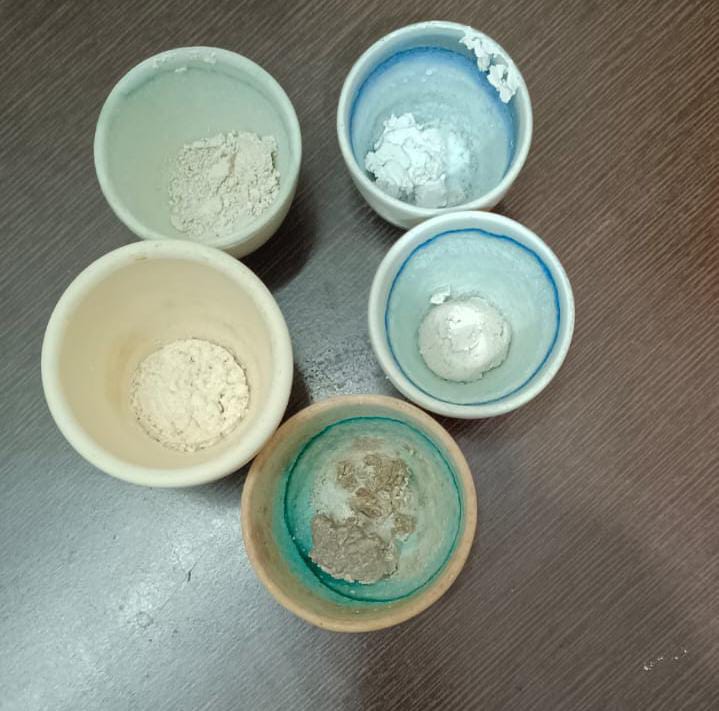
We report the synthesis and detailed investigation of Gd₂O₃, Gd₁.₉₂Ce₀.₀₈O₃, Gd₁.₈₈Ce₀.₁₂O₃, and Gd₁.₈₄Ce₀.₁₆O₃ nanomaterials and their structure–property–activity relationships. X-ray diffraction confirmed the preservation of the cubic Gd₂O₃ phase for all compositions, with systematic peak shifts and broadening indicating successful substitutional incorporation of Ce and lattice distortion. FTIR and XPS analyses revealed a stable metal–oxygen framework with mixed Ce³⁺/Ce⁴⁺ redox states and an increased concentration of oxygen vacancies. BET surface analysis revealed an enhanced surface area and mesoporosity with increasing Ce content, while UV–Vis spectroscopy and Tauc plots demonstrated a progressive narrowing of the band gap and improved visible-light absorption. The photocatalytic activity was evaluated through dye degradation under visible-light irradiation, where Ce-doped samples exhibited significantly enhanced performance compared to pristine Gd₂O₃. Among them, Gd₁.₈₄Ce₀.₁₆O₃ achieved the highest degradation efficiency, attributed to efficient charge separation, defect-assisted electron transfer, and improved surface adsorption. Magnetic studies further indicated tunable magnetic behavior with Ce doping. These results demonstrate that Ce doping is an effective strategy to enhance the photocatalytic activity of Gd₂O₃, making it a promising material for visible-light-driven environmental remediation applications.
December 28, 2025