
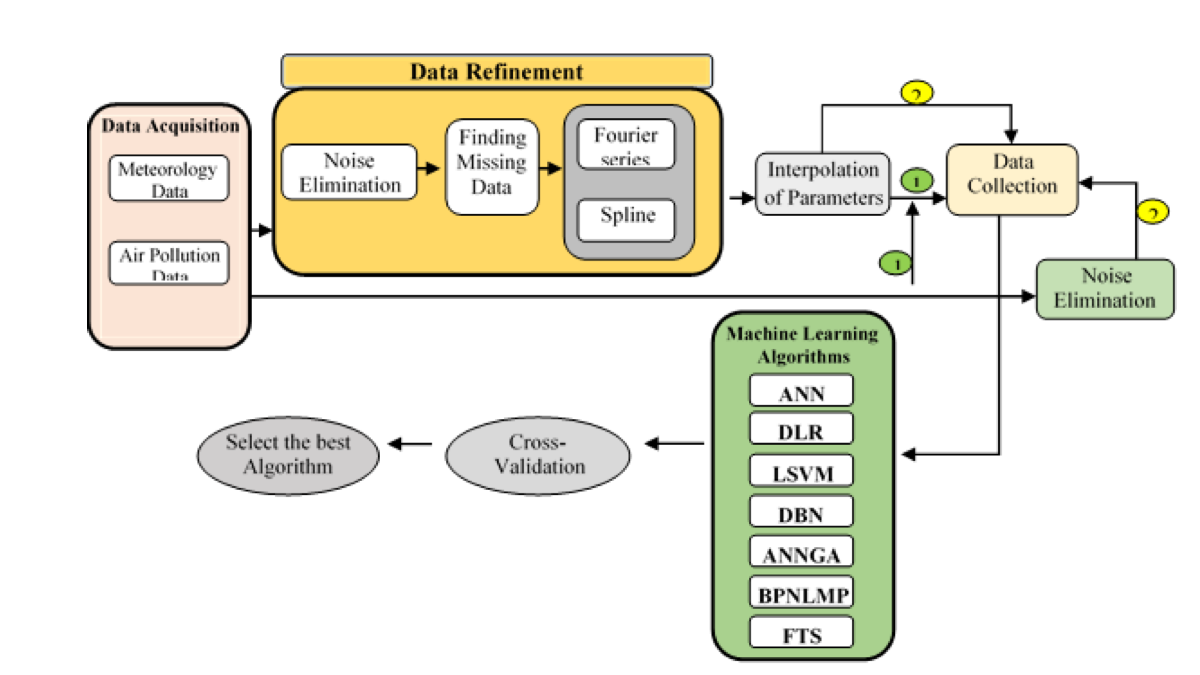
The growing concern for air pollution has been raised by many governments and people worldwide because it affects human health and sustainable development. Particularly, in India, the drastically deteriorating air quality threatens the health of its people. Meanwhile, in smart cities, knowledge of timely and reliable levels of air pollution is essential for the effective set-up of smart pollution systems. The current methods of air quality prediction primarily use shallow models which yield unsatisfactory results. Hence, it has inspired us to research methods of air quality prediction based on models of Neural Network (NN) architecture. In the present study, the NN architecture model was tested on air pollution data to improve the accuracy of prediction models. The two approaches proposed in this work are based on the Artificial Neural Network (ANN). The first method uses the Artificial Neural Network-Linear Vector Quantization (ANN-LVQ). It is an integration of the NN with LVQ, a significant Air Prediction Technique. The second method is a fusion of MultiLayer Perceptron Neural Network with Self Organization Map (MLPNN-SOM) technique. The main aims of implementing these methods are to provide early warnings by predicting air quality and estimate the influencing pollutant that contaminates the quality of air which thereby leads to air pollution. Upon analyzing literature review, feature extraction methods such as Feature Importance (FI), Principal Component Analysis (PCA), REFLIF-F and Self Organization Map (SOM) were considered based on the complexity of the problem. Feature selection is a process where the features in data are automatically selected to contribute to the prediction variable. After comparing the above-listed feature selection methods, the SOM method performed well in terms of accuracy and processing time. SOM visualization values were used as a similarity measure between the parameter that is to be forecasted and the parameters for the feature space. This method leads to the smallest set of parameters which surpass a similarity threshold. Next, to obtain the influencing pollutant that increases the AQI value, the second proposed fusion method (MLPNN-SOM) was employed to estimate the influencing pollutant which involves two phases. The first phase deals with the feature extraction technique. During the first phase, SOM was selected after comparing all other feature selection methods due to its accuracy and processing time. Based on the results, the proposed MLPNN-SOM method performed better than the other standard clustering. Network components such as activation function, learning rate, momentum, nodes and network structure strongly influence the classification performance of NN. Having said that, proper selection of weights and biases reduces the classification error. Therefore, in this study, the NN architecture was fine-tuned to enhance the classification performance by optimizing weights and biases deliberately.
December 28, 2025