
Objectives
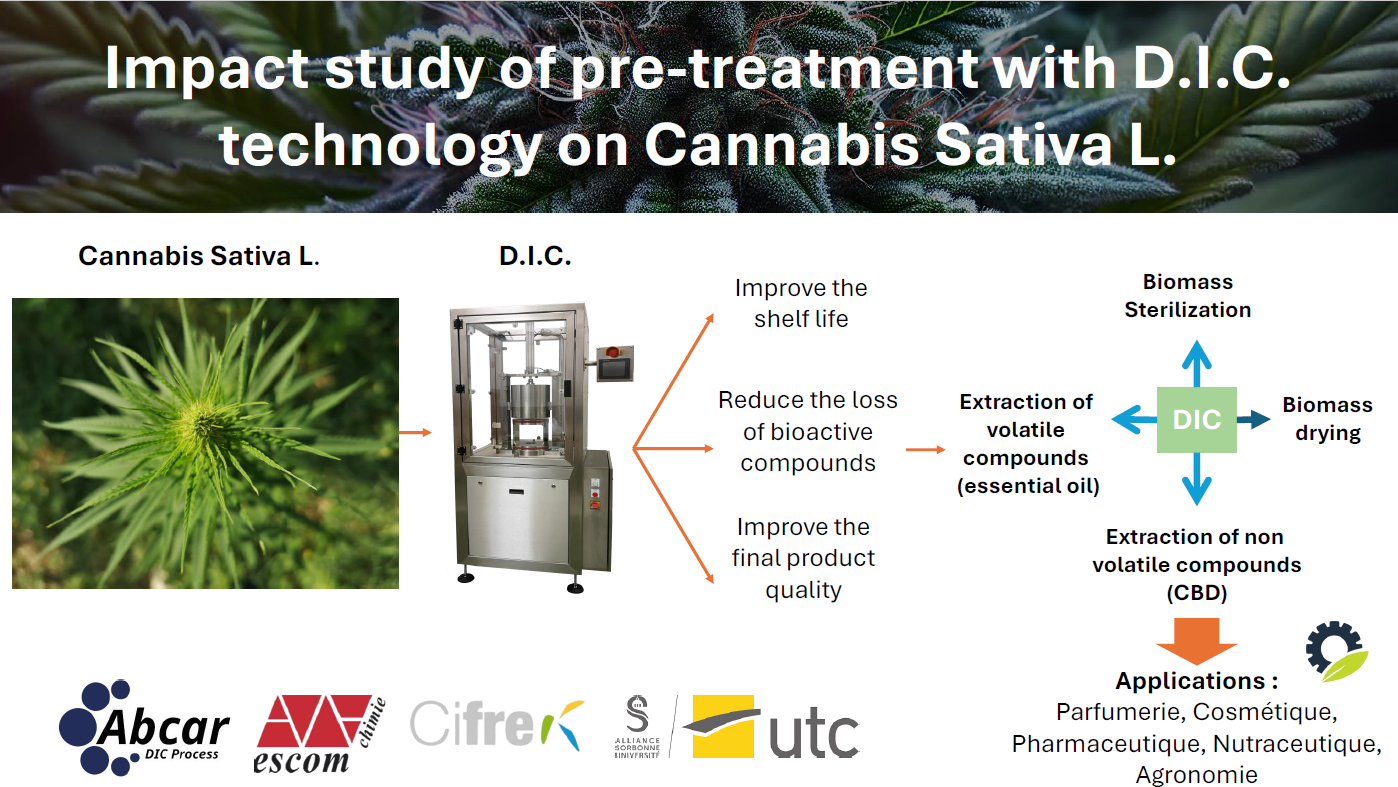
Instant Controlled Pressure Drop (DIC) is an emerging agri-food technology that applies high-temperature, short-time treatments, altering material structures by expansion while preserving product quality. DIC shows promise for applications such as biomolecule drying, sterilization, and extraction, reducing energy costs and better preserving product quality compared to conventional processes. This research aims to determine the impact of DIC pretreatment on the extraction of essential oils and cannabidiol (CBD) from Cannabis Sativa L. buds. Objectives include decarboxylating the plant, improving extraction efficiency, preserving compounds, increasing storage stability, and exploring product and byproduct applications. This work investigates how to enhance process efficiency from harvest to product formulation by integrating DIC technology for hemp pretreatment, addressing scientific challenges, and offering higher-quality hemp products.
Methods
DIC processing was performed using pilot equipment from ABCAR DIC Process (France). The DIC process involves increasing the pressure in the treatment chamber, maintaining it, and then depressurizing the chamber. Typical parameters include:
• Pressure
• Duration
• Number of cycles
Treatment parameters were optimized based on the plant material and the target outcomes, aiming to decontaminate and decarboxylate the flowers, and improve the extraction of bioactive compounds. Parameters ranged from 1 to 35 seconds, 1 to 6 bars, and 1 to 8 cycles.
CBD extraction kinetics were studied by dynamic maceration on samples of hemp buds:
• Non-treated
• Treated by DIC
• Non-treated and steam distilled
• Treated and steam distilled
CBD yield was determined by gas phase chromatography analysis coupled with mass spectrometry (GC-MS).
Results
The decarboxylation rate of CBDA to CBD was assessed by comparing concentrations of CBDA and CBD in the extracts. DIC treatment alone achieved a decarboxylation more than 80%. DIC treatment significantly enhanced the extraction kinetics of CBD. The conventional extraction method yielded 140.94 mg of CBD after 15 minutes, whereas with DIC pre-treatment, a similar amount (135.49 mg) was recovered in just 5 minutes. The aromatic profile of the essential oils, analyzed by GC-MS, revealed differences between oils extracted from DIC-treated buds and those obtained by traditional methods. Oils from DIC-treated buds demonstrated a fractionated extraction of volatile and non-volatile compounds. DIC treatment significantly improved drying efficiency, shortening the drying time to one-third of the traditional process. This results in reaching the target moisture content in just 640 minutes compared to the traditional 1920 minutes. The antimicrobial effectiveness of DIC was evaluated by comparing microbial colony counts (bacteria and fungi) on treated versus untreated hemp buds. DIC treatment reduced microbial counts by approximately 4 log (cfu/g of dried buds), highlighting DIC’s effectiveness for plant product decontamination and improved storage stability. Essential oils in the discharge waters of the DIC equipment formed stable emulsions, showing promise for bio-pesticide formulation. These emulsions, classified between nanoemulsions and macroemulsions, exhibited potential as fungicidal pesticides, insecticides, and nematicides, indicating additional applications for DIC-treated hemp flowers.
December 28, 2025