
Background: Pet ownership is universal. 66% of US households (86.9 million households) had a pet in 2024, and 97% of pet owners consider their pets to be a part of their family. Various studies show that caring for pets and interacting with them help pet owners improve their physical and mental wellbeing and, in turn, their life satisfaction.
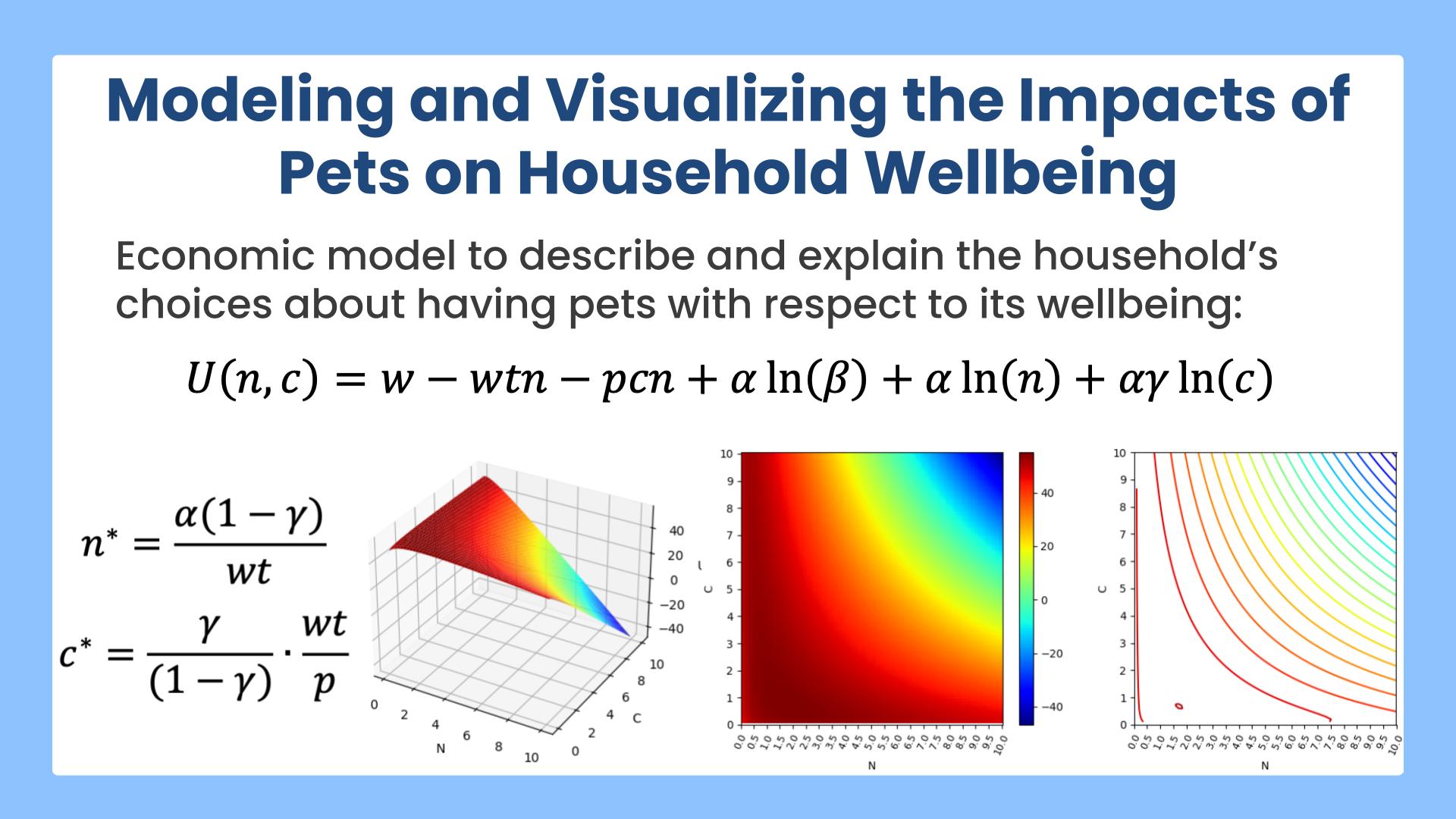
Objective: Since pets become a vital part of the family, they should be considered in the economics of the household as other household members are. However, pets have barely been analyzed formally in economics or any other disciplines. Therefore, this work studies a formal model that applies economic principles, such as utility optimization, budget and time constraints, opportunity cost, and diminishing marginal utility, to describe and explain the household’s choices about having pets.
Methodology: Assuming the demand for pets is analogous to the demand for children, the proposed model follows the microeconomic theories of the household, particularly for fertility. Economic analysis of fertility was pioneered by Becker (1960, 1973), and his framework inspired numerous subsequent models (Doepke et al., 2023). The model in this work is particularly inspired by de la Croix and Doepke (2003) and Apps and Rees (2004).
The proposed model considers key economic parameters in pet ownership choices such as the household preference to have pets, the number and welfare of pets, the price of pet care goods and services, the time spent for caregiving, the household income, and the household utility (household wellbeing). Based on the model, this work formulates an optimization problem in which a household maximizes its utility as a rational economic agent by choosing an optimal combination of those economic parameters.
Results: This work solves the optimization problem analytically through a marginal cost-benefit analysis and finds the optimal number of pets and the optimal time spent for pet care with respect to the household utility. This work also carries out computational experiments by supplying empirical data to the model. Experimental results illustrate a utility landscape for average pet owners in the US and reveal the combinations of parameter values at and around the utility equilibrium.
This work is intended to aid the current and prospective pet owners to explore quantitative economic reasoning about pet ownership in the hope of reducing the chances of impulse pet acquisition, helping schedule pet care routines better, and reversing the on-going trend of pet relinquishment.
Becker, G. (1960) An economic analysis of fertility, Demographic and Economic Change in Developed Countries, Columbia University Press.
Becker, G. and Lewis, H. (1973) On the Interaction between the Quantity and Quality of Children, J Political Econ, 81(2):S279–S288.
Doepke, M., Hannusch, A., Kindermann, F. et al. (2023) The Economics of Fertility: A New Era, Handbook of the Economics of the Family, 1(1), Chapter 4, North-Holland, 2023.
de la Croix, D. and Doepke, M. (2003) Inequality and Growth: Why Differential Fertility Matters, Am Econ Rev, 93(4):1091–113.
Apps, P. and Rees, R. (2004) Fertility, Taxation and Family Policy, Scand J Econ, 106(4): 745–763.