
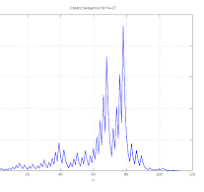
The Collatz Conjecture, also known as the “3x + 1 problem,” is a longstanding unsolved problem in mathematics that examines the behavior of positive integers under a simple iterative rule. Specifically, if a number is even, it is halved; if odd, it is multiplied by three and increased by one. Despite its apparent simplicity, the conjecture remains unproven, positing that all positive integers eventually reach the cycle 4-2-1 through repeated application of these operations. Rooted in number theory and dynamical systems, the problem has captivated mathematicians and researchers across various fields due to its complex, chaotic behavior and the challenge it presents in proving or disproving the assertion. An illustrative example of its intricacy is the uncertainty surrounding whether the expression (3x+1)/2 results in an even or odd number. Beyond its mathematical implications, the Collatz Conjecture has found relevance in other disciplines, particularly physics, where it contributes to studies of complex systems, energy dissipation, and chaos theory. One notable observation pertaining to randomness is that when the logarithm of the Collatz function’s graph is taken and the linear trend is removed, the resulting pattern closely resembles fluctuations observed in financial markets. In computer science, it offers insights into algorithmic complexity and recursive processes. The conjecture exemplifies how seemingly simple rules can generate intricate and unpredictable patterns, making it a profound and enduring subject of study in both theoretical and applied sciences.
December 28, 2025