
The pharmaceutical industry faces mounting challenges in developing new drugs, with traditional computational methods often falling short when modeling complex molecular interactions. Quantum computing has emerged as a promising solution to overcome these limitations, offering unprecedented computational power to tackle problems that are intractable for classical computers. By leveraging quantum mechanical principles such as superposition and entanglement, quantum algorithms can simulate molecular behavior with remarkable accuracy, enabling researchers to predict drug-target interactions, optimize molecular structures, and identify promising drug candidates more efficiently. Current applications of quantum computing in drug discovery focus on several key areas: molecular simulation, protein folding prediction, and optimization of lead compounds. Unlike classical computers that struggle with the exponential complexity of quantum systems, quantum computers can naturally represent and manipulate quantum states, making them ideal for modeling chemical reactions and molecular dynamics. Early implementations have demonstrated significant potential in reducing the time and cost associated with the drug discovery pipeline, which traditionally spans over a decade and costs billions of dollars. Despite these promising advances, practical challenges remain. Today’s quantum computers are still in the noisy intermediate-scale quantum (NISQ) era, characterized by limited qubit counts and high error rates. However, as hardware improves and hybrid quantum-classical algorithms become more sophisticated, the pharmaceutical industry is increasingly investing in quantum computing partnerships and research initiatives. This convergence of quantum technology and pharmaceutical science represents a paradigm shift that could revolutionize how we discover and develop life-saving medications in the coming decades.
December 25, 2025
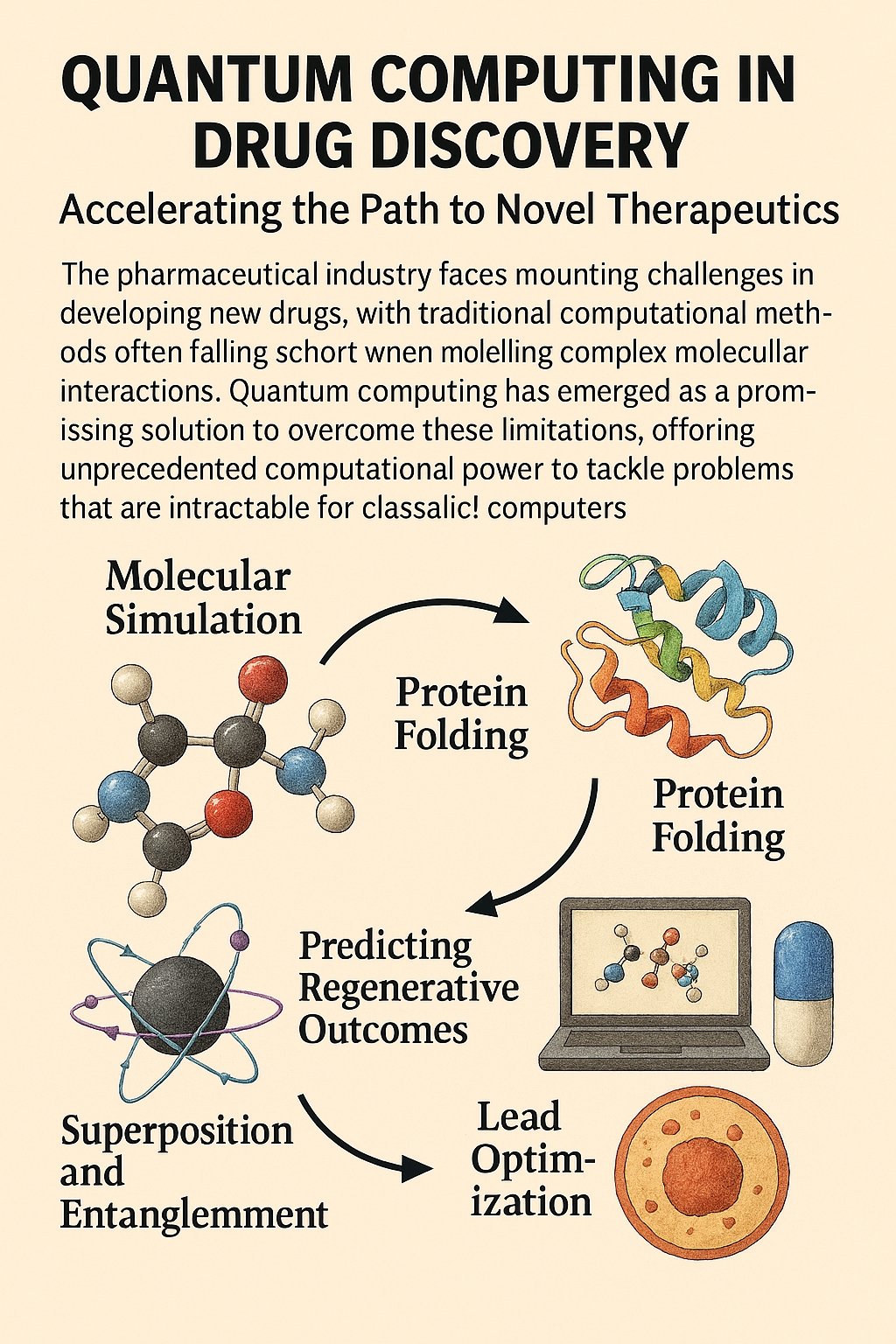
Quantum Computing in Drug Discovery: Accelerating the Path to Novel Therapeutics
Authors List :
Mohammed Mansoor Waheed, Humera Quadriya, Fehmida Begum, Shagufta Tarannum, Majid Mohiuddin
Presenting Author :
Mohammed Mansoor Waheed
Affiliations :
Anwarul Uloom College
Email :
mohammadmansoor651@gmail.com
Key Words (5 Words Maximum) :
Drug Discovery, Molecular Simulation, noisy intermediate-scale quantum (NISQ), Protein Folding, Quantum Dots,