
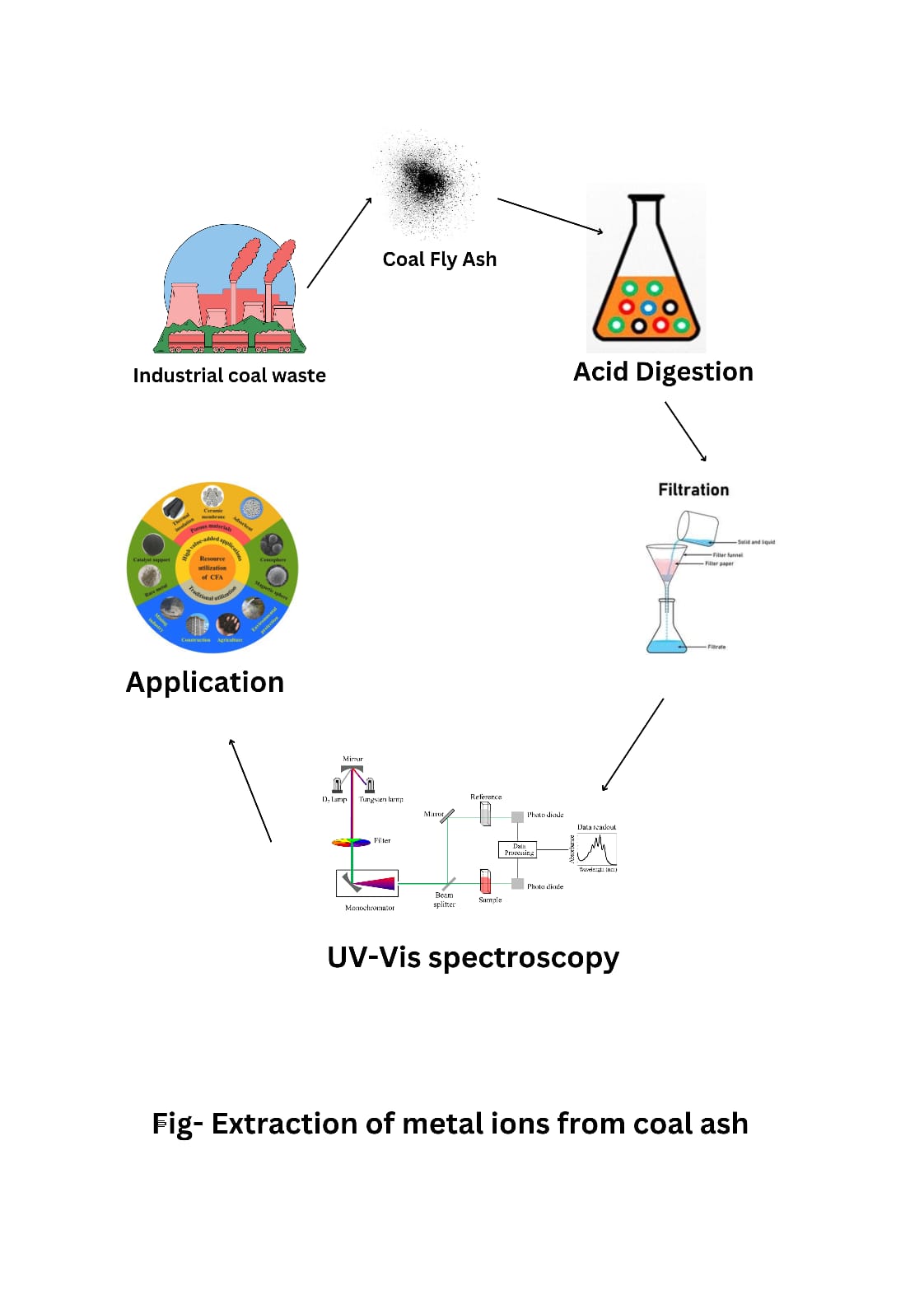
Coal ash, a byproduct of coal combustion in thermal power plants, poses significant environmental challenges due to its abundance and complex composition. It primarily comprises fly ash, bottom ash, boiler slag, and flue gas desulfurization (FGD) residues, varying in particle size, mineralogy, and trace element content. These waste materials often contain valuable metals, rare earth elements (REEs), and hazardous components such as heavy metals, necessitating efficient recovery and management strategies. This study explores the application of the acid leaching method for selective extraction of valuable elements from coal ash, employing mineral acids such as HCl or H2SO4 to dissolve metal ions for subsequent recovery. UV-visible spectroscopy is utilized to monitor leachate composition and evaluate the extraction efficiency of key elements. An advanced elemental detection technique, energy-dispersive X-ray spectroscopy (EDX), is employed to quantify the elemental content and analyze the chemical composition of raw and treated coal ash samples. By optimizing parameters like acid concentration, temperature, and reaction time, this research aims to enhance the sustainable utilization of coal ash. The findings underscore the dual potential of mitigating environmental risks associated with coal ash disposal and recovering critical resources, aligning with circular economy principles.
December 28, 2025